Hotel Wardrobe Buying Guide: Steel vs Wood, Sizing Tips, and 5 Key Questions Before Ordering
Outfitting 30 guest rooms? The wardrobe choice you make now stays with the property for the next decade. Pick wood that warps in a humid coastal room, or a cabinet too deep for a narrow corridor, and you’re replacing it before the next renovation cycle. This guide walks through steel versus wood, how to size a wardrobe to the actual room, and the five questions that separate a smart order from a regret.
It’s written for hotel owners, interior designers, and procurement teams ordering in batches — not for a single home bedroom. Everything below can be confirmed in the quotation before you commit.
Steel vs. Wood: The Honest Comparison
The first decision is material. Each has a real place in a hotel, and neither wins everywhere.
| Factor | Steel Wardrobe | Wood / Veneer Wardrobe |
|---|---|---|
| Humidity resistance | Excellent. Powder coat doesn’t swell or warp in coastal or spa-adjacent rooms | Poor in damp rooms. Solid wood expands, veneer peels near bathrooms |
| Durability under heavy use | 10–15 years, dents but doesn’t split | 8–12 years, scratches show, hinges loosen over time |
| Warmth and look | Modern, clean; available in soft powder colors | Classic, warm; preferred in boutique and heritage hotels |
| Weight and shipping | Lighter per unit, flat-pack friendly | Heavier, higher freight, more damage in transit |
| Maintenance | Wipe with a damp cloth. No refinishing | Needs occasional oil or wax; chips need touch-up |
| Per-unit cost (batch) | Lower, especially at volume | Higher, solid wood far more than veneer |
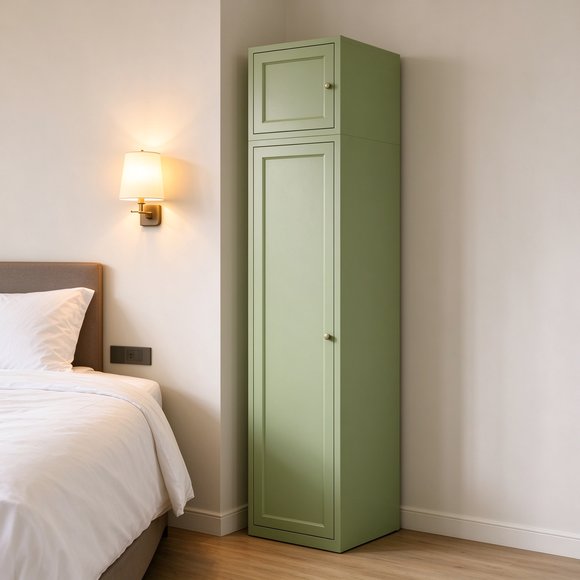
The honest middle ground: a powder-coated steel cabinet finished in warm milky white, bean green, or cherry blossom pink reads as furniture, not office storage. Guests rarely identify it as metal unless you tell them. For coastal properties, spa hotels, and high-turnover budget or mid-scale chains, steel usually wins on total cost of ownership.
Sizing Tips: Fit the Room, Not the Catalog
Buyers order from a spec sheet and discover on delivery that the wardrobe blocks the door swing or leaves no walking path. Measure three things before you size:
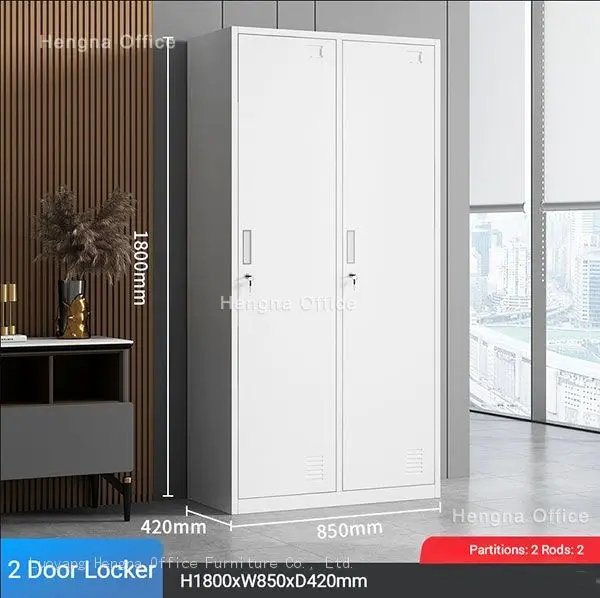
1. Wall width after the bed and TV. Sketch the room on paper. Mark the bed, the desk, the TV wall, and the door swing arc. The wardrobe goes in the remaining gap. A standard single-door steel wardrobe sits around 420 mm wide; a double door runs 800–900 mm. Choose the version that leaves a clear 600 mm walking lane.
2. Ceiling height. Standard rooms with 2.4 m ceilings take the 1800 mm cabinet comfortably. Rooms with higher ceilings or a need for out-of-season storage use the 2200 mm version with a separate overhead compartment for luggage and spare bedding.
3. Door swing direction. The cabinet hinge can be mounted left or right during assembly. Match it to which side of the wall the room door opens from, so the wardrobe door doesn’t collide with the entry door or the bed.
Depth matters too. A wardrobe at 420 mm deep holds hangers and folded items without jutting into the room. Deeper cabinets (500 mm+) eat floor space and suit only rooms with a dedicated closet alcove.
Don’t forget housekeeping access. The cabinet door needs room to open fully so a maid can wipe the shelf and replace hangers without squeezing past the bed. If the wardrobe sits beside a narrow entry, choose a model whose door opens away from the bed rather than into the walking lane. Measure the open door’s arc on paper before you finalize the hinge side.
The 5 Key Questions Before You Order
Run these five past your supplier before signing. The answers shape the quote more than the catalog price.
1. How many rooms, and are they identical layouts? Uniform rooms let you order one configuration in bulk and lock in volume pricing. Mixed layouts mean two or three cabinet sizes — tell the supplier the count for each.
2. What’s the local humidity and climate? Coastal, tropical, or pool-adjacent properties should specify steel over wood. Ask whether the powder coat is rated for that environment; confirm in the quotation.
3. Do you need a lock, and who holds the master? Guest rooms need privacy locks. A master-key system lets housekeeping open a stuck or locked room. Decide this before order, because lock type changes the hardware bill.
4. Flat-pack or pre-assembled delivery? Flat-pack saves freight but needs on-site assembly labor. Pre-assembled units arrive ready to wheel in. Count your installation crew’s available hours before choosing.
5. What voltage or non-electronic features apply, and can colors match the brand? Steel cabinets take custom powder colors to match your interior palette. Ask for a color sample board before committing to a batch of 30 or more.
Inside the Cabinet: What Guests Actually Use
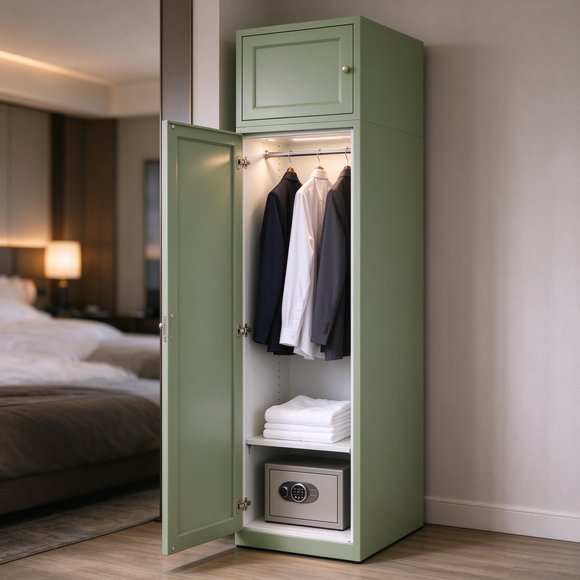
Inside, guests need a hanging rod for coats and hangers, one adjustable shelf for folded clothes and a suitcase, and a small space for shoes. A cabinet crammed with fixed shelves looks efficient but doesn’t work for real luggage.
The hanging rod should sit around 1.5 m high, clear of the shelf above. Shelf height adjusts in increments so you can raise it for long dresses or lower it for folded sweaters. Each shelf carries a substantial load because steel doesn’t sag the way thin wood board does over years.
Guests rarely fill a wardrobe to capacity, but they always need somewhere to put a suitcase, a coat, and a few folded items. A cabinet that looks over-engineered on the spec sheet usually feels right in use; one that skips the hanging rod to pack in shelves ends up with coats draped over chairs. Prioritize the rod, then add shelf space.
Color and Finish That Won’t Date
Bold colors look great in a mood board and tired in three years. For a chain that wants a consistent look across properties, neutral powder colors — white, milky white, light gray — stay neutral when you repaint the walls later. Soft accent colors (bean green, sky blue, pink) work for boutique rooms where the wardrobe is part of the design statement.
Ask whether the finish is electrostatic powder coating baked on. Baked coating resists the scuffs of luggage wheels and doesn’t yellow near sunlight the way painted MDF does.
Quick Answers
Q: Is a steel wardrobe appropriate for a luxury hotel?
A: Yes, when finished in warm neutral colors with a slim profile. The perception of an office locker comes from gray industrial steel and exposed hasps, not from a properly finished cabinet.
Q: Can I mix steel in some rooms and wood in others?
A: You can, but matching a supplier across both materials complicates maintenance and spare parts. Most chains standardize on one.
Q: How many units qualify for bulk pricing?
A: Volume terms typically improve at 10+ units, confirmed in the quotation. Multi-property rollouts get better terms still.
Q: Do cabinets arrive assembled?
A: Depends on the model and shipping method. State your assembly expectation up front so it’s in the quote, not discovered at delivery.
Q: What’s the warranty on hotel-grade cabinets?
A: One year standard on the full cabinet, with the powder coat and hardware covered for replacement within that period, confirmed in the quotation.
Get Your Quote
Send us your room count, a couple of layout sketches, and your preferred finish color. We’ll send sizing options and a batch quotation within 24 hours. Chain rollouts and multi-property projects get volume terms confirmed in the quotation.