ABS Pool Lockers for Swimming Pool Changing Rooms — Rust-Proof, 80mm Base, Tool-Free Assembly
You walk into a public swimming pool changing room. The air is thick with chlorine. The floor is wet. The old steel lockers along the wall are rusting at the corners, peeling where the humidity got under the paint, and the doors stick because the metal has swollen. Someone wrote their phone number in the rust dust.
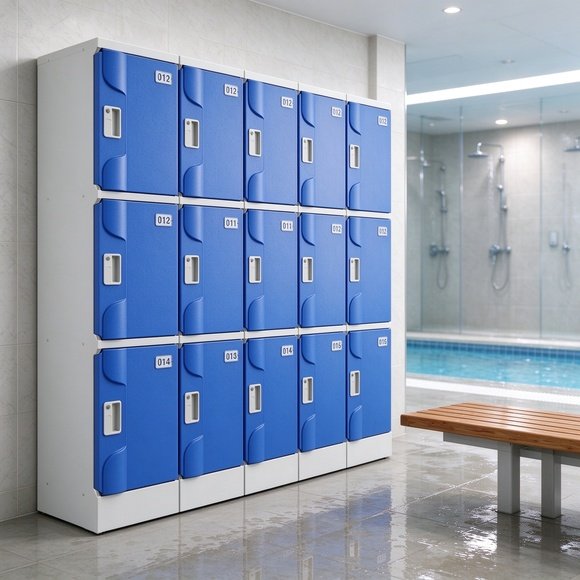
If you’re outfitting a pool, a water park, a spa, or a gym with wet changing areas, ABS pool lockers are the upgrade that stops the rust cycle. They’re injection-molded from engineering plastic, sit on an 80 mm moisture base, and go together without tools. No paint to peel, no steel to corrode, no screws to seize in damp air.
Why Steel Lockers Fail Around Pools
Steel is the default locker material for offices and schools. Around water, it loses. Pool air carries chlorinated moisture that settles on every surface. A steel cabinet that looks fine in October is rusting along the bottom edge by March. The paint chips, the edges go orange, and the locker starts to look neglected within a year of installation.
It’s not just appearance. Rust dust gets on swimwear, wet towels, and personal items. A rusted hinge binds, and a door that won’t open becomes a facilities call-out. By year three, you’re repainting or replacing cabinets that should have lasted a decade.
ABS plastic doesn’t rust. It doesn’t need paint. Wipe it down after a shift and it looks the same in year five as it did on day one. That’s the whole argument for plastic in wet areas.
80 mm Base: Why It Matters in a Wet Room
The floor of a pool changing room is never fully dry. Mops leave standing water. Shower runoff pools around the cabinets. Swimmers drip on their way to the locker.
A standard steel locker sits flush on the floor. The bottom panel wicks up moisture, and rust starts from the bottom corner — exactly where you see it in old pool rooms. The ABS cabinet sits on an 80 mm raised base that lifts the body off the wet floor. Air circulates underneath, water runs through, and the cabinet itself stays dry.
The base is part of the molded unit, not an add-on. You don’t bolt feet on after delivery; it comes that way.
Door Configurations for Pool Traffic
Pool lockers need to handle a mix of swimmers: families with kids, lap swimmers with gym bags, guests carrying towels and goggles. The door count depends on your peak load and how long people stay.
| Configuration | Single Cell (W×H×D) | Best For |
|---|---|---|
| 3-door tall | 382×1940×500 mm | Hanging swimwear, robes, gym bags |
| 6-door | 382×930×500 mm | Gyms, sports centers, day-pass users |
| 9-door | 382×620×500 mm | Schools, swim teams, group bookings |
| 12-door | 382×465×500 mm | High-traffic public pools, water parks |
| 18-door | 382×310×500 mm | Compact rooms, maximum density |
Depth options run 390, 420, and 500 mm. Pick 500 mm if users carry full-size gym bags; 420 mm works for towels and smaller personal items.
Tool-Free Assembly: Mortise-and-Tenon, No Screws
Steel lockers ship in flat panels and need a technician with a screwdriver and a wrench. ABS cabinets go together like a big plastic puzzle. The panels have molded mortise-and-tenon joints — you align the tabs, press down, and they click. No screws, no glue, no Allen keys, no power tools.
Two staff members can assemble a 12-run bank in an afternoon. If you reconfigure the room later, the cabinet pulls apart just as cleanly and goes back together. There’s no seized hardware to drill out.
Each cabinet has rounded corners and circular hinge covers. Swimmers carrying wet, slippery towels don’t catch an edge on a sharp corner. That’s a safety detail that matters in a room where people move fast and the floor is slick.
Lock Options: From Padlock to Fingerprint
Pool locker locks need to handle transient users — people who aren’t members, who forget their combination, who lose their key fob. The lock range scales with your budget and security needs.
- Padlock or hasp — the basic option. Users bring their own padlock. Cheapest, but you deal with cut locks and forgotten combinations.
- Mechanical coin return — classic pool setup. Insert a coin, get your stuff back. No cards, no batteries.
- Four-digit code lock — users set their own code. Good for gym members who visit weekly.
- Card swipe — ties into an existing member card system. Best for clubs with recurring membership.
- Fingerprint or touch screen — high-end option. No lost keys, no shared codes, fully contactless.
You can mix lock types across a bank — padlocks for the day-pass section, card swipe for the member wing.
Colors That Survive Wet Rooms
Steel lockers come in gray and maybe beige. ABS cabinets ship in eight standard colors: dark blue, yellow, light blue, light green, orange, pink, white, gray, and a wood-grain finish. Custom colors are available for chain projects.
Color isn’t just decoration in a pool room. It’s a wayfinding tool. Color-code the family changing room in yellow, the lap-swim locker bank in dark blue, the accessible room in light green. Users find their locker faster, and the room reads as organized, not institutional.
What You Get With Each Unit
Inside every cabinet:
- A built-in hanging rod for wet swimwear and robes
- A multifunction storage box for goggles, watches, jewelry, and phones
- Rounded edges and sealed seams that wipe clean
- The 80 mm moisture base integrated into the body
Matching all-plastic benches are available in lengths from 900 to 2000 mm, 400 mm deep, 450 mm high. They don’t rot, don’t splinter, and don’t need wooden slats to replace.
ABS vs. Steel Around Water: The Honest Trade-Off
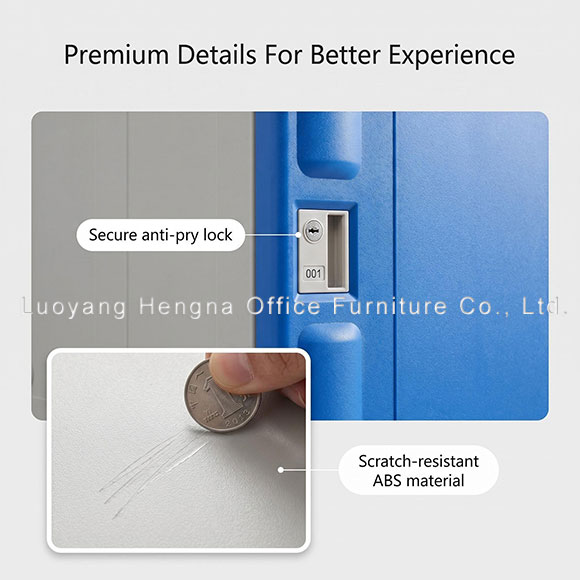
ABS wins on corrosion, weight, and tool-free assembly. It loses on scratch resistance if you drag metal equipment across it, and it’s not the right choice for a dry warehouse or a high-security server room. But for a pool deck, a spa changing room, a water park wet area, or a school shower block, the math is clear: plastic outlasts steel in humidity by years.
The rated design life is 20 years. Steel lockers in a pool environment typically need repainting or replacement within 5–7 years. Over a two-decade window, the plastic cabinet is the lower-cost choice even if the upfront price is similar.
Quick Answers
Q: Can they sit directly on a pool deck?
A: The 80 mm base lifts the cabinet off wet floors. For outdoor decks with direct rain, cover the bank or choose a weather-rated variant, confirmed in the quotation.
Q: How long does assembly take?
A: A 12-door cabinet takes two people about 20–30 minutes. No tools required.
Q: What’s the minimum order?
A: One unit ships. Chain pool projects and water park rollouts get volume pricing confirmed in the quotation.
Q: Do they handle saltwater pools?
A: Yes. ABS is unaffected by salt air or saltwater spray, which is exactly where steel lockers corrode fastest.
Q: Can I buy replacement doors or locks?
A: Yes. Individual doors, hinges, and lock mechanisms are available as spare parts. Tell us your order number and we’ll ship the matching components.
Get Your Quote
Tell us your room dimensions, peak swimmer count, and which lock type fits your operation. We’ll send a spec sheet and FOB pricing within 24 hours. Multi-bank pool projects, water parks, and municipal swimming centers get volume terms confirmed in the quotation.