How to Choose Safe School Lockers for Elementary Classrooms — A Guide for Teachers, Parents, and Facility Managers
When was the last time you really looked at the lockers in your child’s classroom?
Probably never. They’re just there. Unnoticed. Day after day, year after year.
But ask any elementary school teacher: “Has a kid been hurt by the lockers in your classroom?” The answer is almost always yes. A bumped head. A pinched finger. A backpack caught on a sharp edge. Nothing serious enough to make the news, but serious enough to make a child cry and a parent angry.
It’s not the teacher’s fault. And it’s not the child’s fault for being careless. It’s the locker’s design. Most classroom lockers were built for office workers, not for children.
Why Safe School Lockers for Elementary Classrooms Are Different from Office Ones
An adult opens their locker once in the morning and once in the evening. Maybe twice.
An elementary school student opens theirs 8–10 times a day. Between every class. Before and after lunch. During recess. They run to it. They throw the door open. They grab a book. They slam it shut. They bump into the next one on the way out.
Over four years, a single locker door cycles over 10,000 times. That’s not normal use. That’s an endurance test.
A classroom locker needs to survive that abuse. More importantly, it needs to be safe during it.
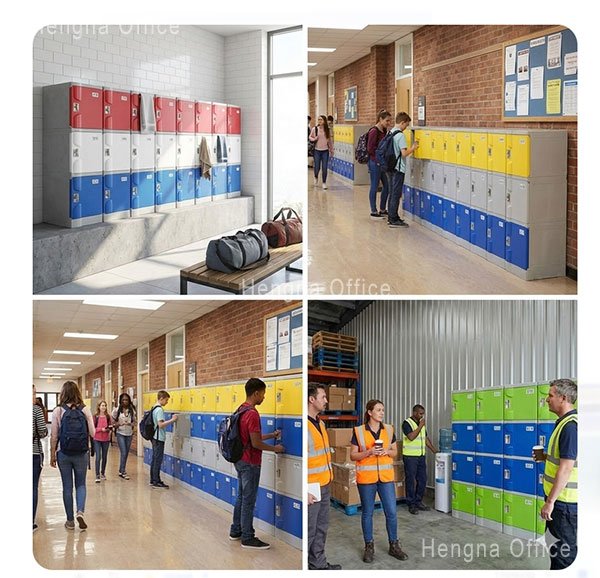
Three Things to Check Before Buying Classroom Lockers
1. Corners — Are They Rounded or Sharp?
This is the most direct safety indicator.
Sharp metal corners are fine for adults who pay attention. But children don’t. A metal corner at waist height is exactly where a running child will hit it. Some schools stick foam corner guards on metal lockers. Those guards fall off within months, leaving sticky residue behind — uglier than the original metal.
Rounded-corner lockers solve this at the design level. The corners are molded into a smooth curve — not “rounded off” after manufacturing, but born curved. Bump into one and it hurts for a second. It doesn’t draw blood.
How to check: Run your hand along every edge and corner of the locker. If any part catches or scratches your palm, it’s not safe enough for a classroom.
2. Odor — Does the Locker Smell Like Chemicals?
New furniture in a classroom means one question: formaldehyde.
Some metal lockers look safe, but the door panels have glued layers inside. Particle board and MDF are even worse — the adhesives release formaldehyde that takes weeks or months to air out. If lockers are installed the week before school starts, children are breathing that air from day one.
The safest option is a locker with zero adhesives. ABS plastic lockers are injection-molded in one piece — no glue, no laminates, no off-gassing. Open the box, put it in the classroom, use it the same day.
How to check: When a new locker arrives, open the door and put your face close to the interior. Take a deep breath. A sharp chemical smell or a sweet glue-like odor means the material is off-gassing. No smell, or a faint plastic scent that disappears after a few hours of ventilation — that’s normal.
3. Stability — Does the Cabinet Wobble?
School lockers are usually installed in a row. If the floor is uneven, the leveling feet aren’t adjusted, or the cabinet isn’t anchored to the wall — a student leaning against it to open a door can rock the entire row.
Young children open lockers by leaning their body weight into the door. If the cabinet isn’t steady, the force of opening a single door can wobble the whole row. It usually doesn’t tip. But when it does, it goes down like dominoes.
How to check: Place both hands on top of the locker row. Push and pull in all four directions. Any visible movement beyond 2–3 cm means the installation is not secure. Check that all leveling feet are making full contact with the floor and that wall anchors are present.
Three Different People, Three Different Concerns
Teachers care about: Will a child get hurt? A teacher manages 30–40 children. Each one has parents. Rounded corners, zero formaldehyde, doors that don’t slam on fingers — these are the things a teacher shouldn’t have to worry about. A safe locker removes that worry before it becomes a problem.
Parents care about: Is the classroom environment safe? Most parents don’t walk in and inspect the lockers. But they notice when their child comes home with a bruise. They notice a chemical smell in the hallway. They notice — and they ask questions. A school that chose safe lockers has good answers ready.
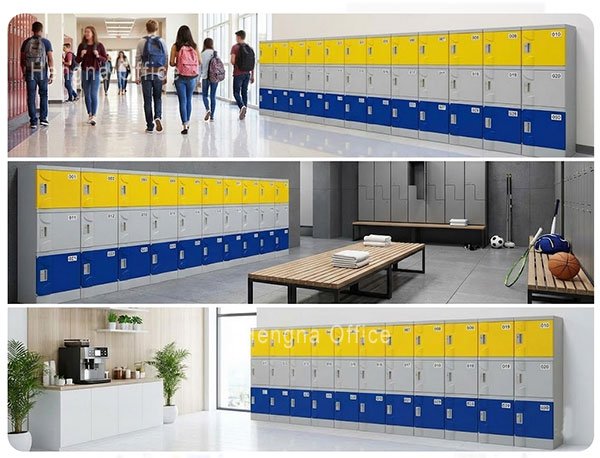
Facility managers care about: Will these last? A facility manager’s question is never “does it look nice?” It’s “how long will this last, and can I get replacement parts in five years?” Modular lockers win here — replace a single door, not the whole row. Doors, locks, hinges — all available as spare parts. Much cheaper than replacing an entire cabinet.
Four Common Mistakes When Buying School Lockers
Mistake 1: Comparing price without comparing materials. Cheap lockers always have a hidden cost. Thin-gauge steel bends and dents. Low-density particle board off-gasses for months. ABS lockers cost more upfront. Over ten years, they cost less — because you don’t replace them halfway through.
Mistake 2: Judging by looks, not by design. Some lockers look rounded. Look closer — they just filed the factory corners down. The core is still a sharp metal edge. True safety comes from molded rounded corners, inside and out.
Mistake 3: Buying the cheapest lock available. Classroom locks don’t need high security. They need to work smoothly. A lock that sticks makes a child yank at the door repeatedly. Over time, that bends the hinge. A smooth key lock or a combination lock — either one, as long as it opens and closes easily.
Mistake 4: Ignoring the base and moisture protection. In humid climates, locker bases sit on wet floors. Metal feet rust within months. Wood swells and cracks. A locker with an 80 mm raised base keeps the cabinet off the floor. Water from mopping never touches it. Air flows underneath and prevents mold.
Quick Reference: Classroom Locker Buying Checklist
| Check Item | Pass Standard | Acceptable | Not Acceptable |
|---|---|---|---|
| Corners | Fully rounded, no right angles | Molded curved corners | Filed-down corners, foam edge guards |
| Formaldehyde | Zero adhesives in construction | ABS or all-metal, no odor | Particle board, MDF, strong glue smell |
| Stability | No visible wobble | Wall-anchored + leveled feet | Floor not anchored, cabinet rocks |
| Door closure | Soft-close or gentle push | Magnetic or slow-close hinge | Must be slammed to latch |
| Lock | Smooth open and close | Key lock or combination, easy action | Sticking latch, stiff key turn |
| Moisture | Cabinet raised off floor | 80 mm base with ventilation gap | Cabinet sits directly on floor |
| Repairability | Parts available individually | Door/hinge/lock replaceable separately | Entire row must be replaced for one broken door |
The Bottom Line
A classroom locker for elementary school doesn’t need to be bulletproof. It doesn’t need to look like a designer piece. It needs to do three things:
- Not hurt a child when they run into it — rounded corners are non-negotiable
- Not release chemicals into the classroom air — zero formaldehyde is the baseline
- Not fall apart after six years of daily use — the structure and materials must handle the abuse
Any locker that passes these three tests — regardless of material or brand — is a good choice for an elementary classroom.
Not Sure Which Locker Fits Your Classroom?
If you’re comparing options and want a second opinion on specs and budget, send us your classroom details — number of students, room dimensions, and your safety priorities. We’ll reply with a configuration drawing and FOB pricing within 24 hours.